
Shaw, George Bernard: 1856-1950
Pygmalion, 1913 - Before Reading (AI Created)
- The play is witty and entertaining on its own, but many of its deeper meanings become clearer when you understand what Shaw was reacting to.
- 1. The title comes from an ancient Greek myth
In Greek mythology, Pygmalion was a sculptor who created a statue of a woman so beautiful that he fell in love with it. The goddess brought the statue, Galatea, to life.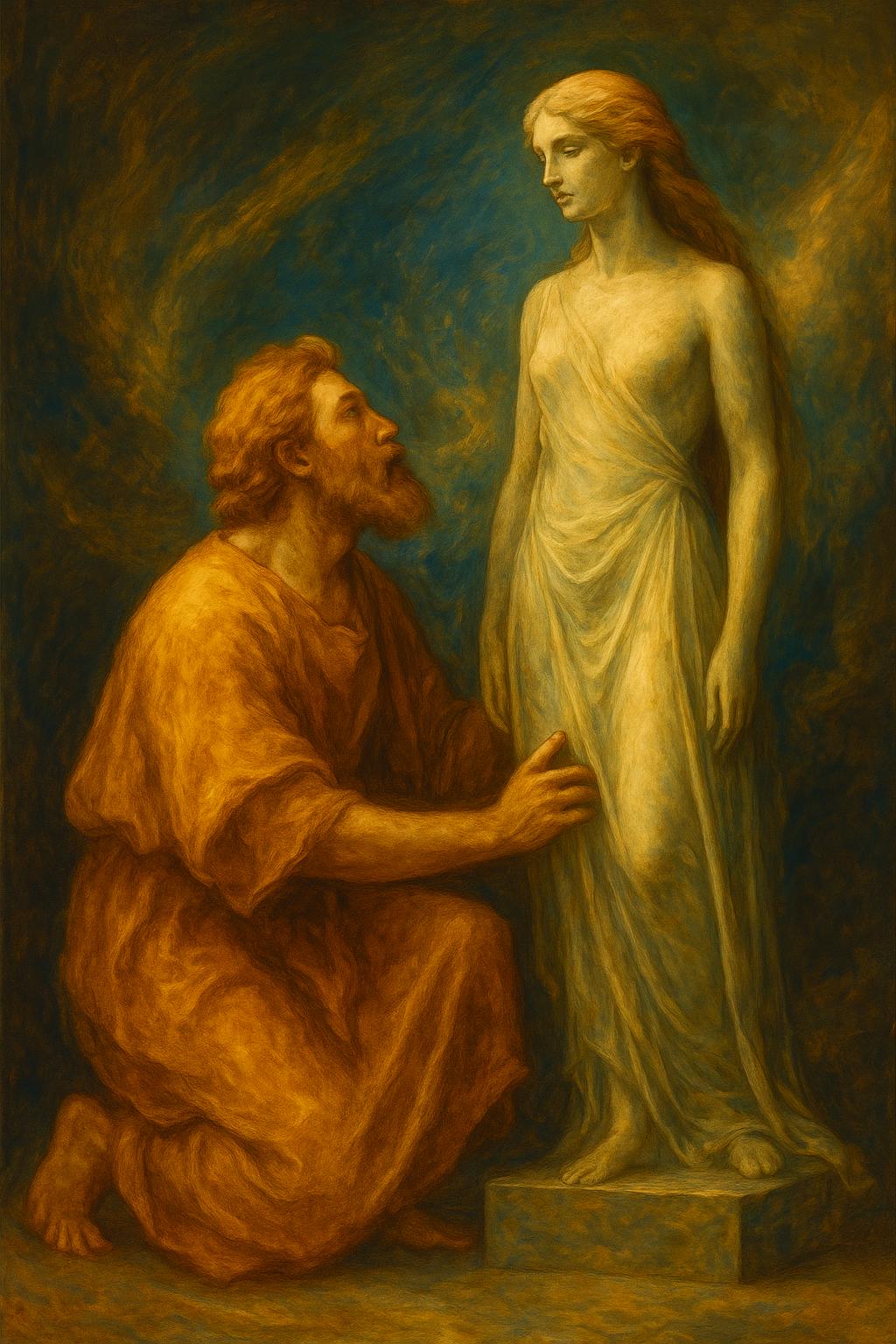
Why it matters:
- Professor Higgins tries to "create" a refined lady out of Eliza Doolittle by changing her speech and manners. Shaw asks whether a person can really be "made" by someone else.
Example: Higgins treats Eliza almost like an experiment rather than an independent person. - 2. Social class in England was strongly connected to speech
In early 20th-century Britain, people often judged social status from accent alone.
Why it matters: The central challenge of the play is not changing Eliza's intelligence but changing how she speaks.
Example: A flower seller with a strong Cockney accent is immediately identified as poor, while someone speaking "proper" English may be assumed to be educated and respectable. - 3. Eliza's transformation is mainly linguistic
Shaw was fascinated by language and pronunciation.
Henry Sweet, a real linguist, partly inspired Higgins.
Why it matters: The play focuses on phonetics—the scientific study of speech sounds.
Example: Higgins can often tell where a person grew up simply by hearing a few words. - 4. Shaw was a social critic, not just a playwright
George Bernard Shaw used comedy to criticize society.
Why it matters: The play is not merely about a makeover. It questions social hierarchies and the idea that upper-class people are naturally superior.
Example: Shaw suggests that differences between classes may be based more on appearance and language than on character. - 5. It is a satire
A satire uses humor to expose problems in society.
Why it matters: Many scenes are funny, but Shaw is making serious points beneath the comedy.
Example: Higgins behaves rudely despite being educated, while some poorer characters show more kindness and practical wisdom. - 6. Eliza is not a passive heroine
Modern readers sometimes expect a simple Cinderella story. Shaw deliberately complicates that expectation.
Why it matters: Eliza develops her own independence and self-respect.
Example: As the play progresses, she begins challenging Higgins instead of simply obeying him. - 7. The play raises questions about identity
One of the major themes is:
- If society treats you differently, do you become a different person?
Example: After learning upper-class speech and manners, Eliza no longer fits comfortably into her old world, but she also struggles to belong completely in the new one. - 8. Gender expectations were different in 1913
Women had fewer rights and opportunities than today.
Why it matters: Eliza's desire for independence was more radical for Shaw's audience than it may seem now.
Example: Many people expected women to rely on fathers or husbands for security. - 9. Don't expect a conventional romance
Many readers come to the play because they know the musical adaptation My Fair Lady.
Why it matters: Shaw did not want the story reduced to a simple romantic ending.
Example: He was more interested in Eliza's autonomy and personal growth than in pairing her with Higgins. - 10. The ending was controversial
Readers and audiences have debated the ending for more than a century.
Why it matters: Shaw intentionally leaves important questions about Eliza's future open to interpretation.
Example: Different productions sometimes emphasize different possibilities for what happens after the play ends. - 11. Learn these key characters before you start
Higgins: Brilliant phonetics expert who trains Eliza
Eliza Doolittle: Flower seller seeking a better futur
Pickering: Gentleman and fellow linguist who treats Eliza respectfully
Alfred Doolittle: Eliza's father; comic but insightful social critic
Mrs. Higgins: Higgins's intelligent mother
Freddy Eynsford-Hill: Young man attracted to Eliza - 12. Watch for Shaw's central question
As you read, keep asking:
- What makes a "lady" or a "gentleman"?
- Is it birth, money, education, language, behavior, or something else?
Nearly every major scene explores this question.
- 1. The title comes from an ancient Greek myth