
Steinbeck, John: 1902-1968
Cannery Row, 1945 - Before Reading (AI Created)
- Before reading Cannery Row, it helps to know some historical, social, and literary context.
- 1. Cannery Row was a real place in California
The novel is set on a real street in Monterey, California.
- In the early 1900s–1940s, Monterey was famous for its sardine-canning industry.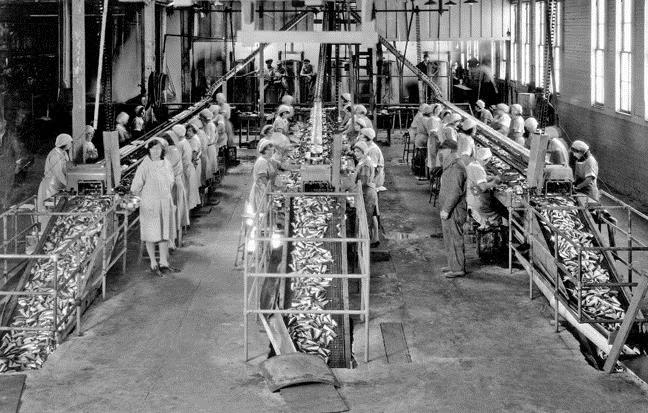
-The street was crowded with factories, fishermen, laborers, and small businesses.
Example: When Steinbeck describes smells, noise, and workers moving through the street, he is drawing from a real industrial community. - 2. The Great Depression shaped the characters
Although the novel is not mainly about the Depression, many characters live with poverty and economic uncertainty.
- People often survive through odd jobs.
- Money is scarce.
- Community support matters more than wealth.
Example: Characters may share food, favors, or labor instead of paying cash. - 3. There is no traditional hero or plot
Many readers expect a novel with one main conflict and a clear climax.
Cannery Row is different.
- It focuses on a community rather than one hero.
- The story moves through episodes and character interactions.
- Everyday life is the main subject.
Example: A party, a conversation, or helping a neighbor can be as important as a dramatic event.
Think of it as a collection of interconnected stories rather than a fast-moving adventure. - 4. Doc is based on a real person
The character Doc was inspired by Ed Ricketts.
- Ricketts was a marine biologist.
- He greatly influenced Steinbeck's thinking.
- He encouraged observing life scientifically and sympathetically.
Example: Doc studies marine life but also understands people deeply, reflecting Ricketts's influence. - 5. Steinbeck avoids judging people
One of the novel's central ideas is that people are complex.
- Good people do bad things.
- Flawed people can be generous.
- Society's "failures" may possess wisdom and kindness.
Example: Characters who appear lazy or irresponsible are often portrayed with dignity and humanity. - 6. The "bums" are important characters
A group led by Mack plays a major role.
- They are poor and often unemployed.
- They live unconventionally.
- Steinbeck portrays them affectionately rather than mockingly.
Example: Mack and his friends frequently create trouble, but their actions often come from friendship and good intentions. - 7. Humor and sadness exist together
The novel can be funny and melancholy at the same time.
Example:
- A comic misunderstanding may make readers laugh.
- The same scene may reveal loneliness or disappointment underneath.
This blend of tones is a hallmark of Steinbeck's writing. - 8. Nature matters as much as people

Steinbeck often connects human life with the natural world.
- Marine animals, tides, and ecosystems appear throughout the novel.
- Nature is not just background scenery.
Example: Observations of tide pools often parallel observations about human communities. In a tide pool, many different creatures live together. They compete, cooperate, hide, feed, and survive in the same small space. Steinbeck looks at Cannery Row in a similar way. - 9. The book celebrates community
One major theme is that people depend on one another.
Example:
- Neighbors help each other despite disagreements.
- Social bonds become more valuable than money or status.
The community itself is almost the novel's main character. - 10. Expect rich descriptions and memorable side characters
Steinbeck loves unusual personalities.
You'll meet:
- Shopkeepers
- Scientists
- Fishermen
- Laborers
- Drifters
- Business owners
Example: A minor character may appear briefly yet receive vivid, unforgettable description. - 11. The language is simple, but the ideas are deep
Steinbeck's prose is generally accessible.
However, beneath the straightforward language are questions about:
- Friendship
- Happiness
- Poverty
- Human dignity
- Society's outsiders
Example: A seemingly simple party can reveal what a community values and how people express affection. - 12. It is often considered one of Steinbeck's warmest books
Unlike some of Steinbeck's darker works such as The Grapes of Wrath or Of Mice and Men, Cannery Row is often remembered for its affection toward ordinary people.
Example: Even when characters fail, Steinbeck usually invites readers to understand them rather than condemn them. - 13. A useful mindset before reading
Don't expect a plot-driven novel.
Pay attention to relationships and atmosphere.
Notice how Steinbeck treats every character with dignity.
Look for connections between nature and human behavior.
Enjoy the community as if it were the true protagonist.
Readers who approach Cannery Row as a portrait of a place and its people usually enjoy it much more than those expecting a conventional story.
- 1. Cannery Row was a real place in California