
Lessing, Doris: 1919 - 2013
Ben, in the World, 2000 - Information About the Book
- General Information | Facts | Author | Commentary | Articles
- General Information
-
Good for Discussing:
Isolation and Belonging
Human Cruelty and Prejudice
Social Critique - This is the sequel to "The Fifth Child." At eighteen, Ben is in the world, but not of it. He is too large, too awkward, too inhumanly made. Now estranged from his family, he must find his own path in life. See Summary.
- Information from Wikipedia
-
Doris Lessing’s inspiration for writing “Ben, in the World.”Lessing’s novels often delve into themes of identity and the limits of human belonging. In “The Fifth Child” and its sequel, “Ben, in the World,” she examines these themes through the character of Ben Lovatt, an atavistic figure who struggles to find his place in the world. This exploration of Ben’s identity and his quest for belonging underscores Lessing’s interest in the social dynamics of exclusion and acceptance.
-
Good for Discussing:
- Facts
- Awards: While "Ben, in the World" received critical attention and appreciation, it did not win major literary awards.
- Alienation and Otherness
Ben is depicted as a figure who is constantly rejected and misunderstood by society due to his unusual appearance and behavior. This theme explores the idea of what it means to be an outsider and how society treats those who are different. The novel details Ben's journey across different countries and communities in his quest to find a place where he can fit in and be accepted.Human Nature and Compassion
Through Ben's interactions with various characters, the novel delves into the range of human responses to those who are different. Some characters show compassion and kindness, while others display cruelty and exploitation. The story raises questions about moral responsibility and the ethical treatment of those who do not conform to societal norms.Social Critique
Lessing uses Ben's experiences to critique modern societal values and the often superficial judgments people make based on appearance and conformity. The novel highlights the economic and social marginalization faced by those who do not fit into the mainstream, showing how Ben is often taken advantage of or discarded by society.Identity and Self-Discovery
Alongside his physical journey, the novel explores Ben's inner journey as he grapples with his identity and attempts to understand himself and his place in the world. Ben's sense of isolation and loneliness is a recurring theme, emphasizing the emotional and psychological impact of being an outsider.Nature vs. Nurture
Ben's condition is often seen as a genetic anomaly, prompting discussions about the nature of his differences and whether they are innate or exacerbated by societal treatment. The novel also touches on how Ben’s upbringing and the reactions of those around him have shaped his experiences and identity.Global Journey and Cross-Cultural Encounters
Ben's travels take him from England to France, Brazil, and the United States, allowing for a diverse portrayal of cultures and environments. Through these settings, the novel explores how different cultures respond to those who are different and the universal aspects of human nature. - Critics generally acknowledge Lessing's skill in developing Ben's character. Her writing style is often described as precise and evocative.
The book received mixed reviews from critics. Some praised Lessing for her bravery in tackling uncomfortable subjects and for her empathetic portrayal of an outcast. Others felt the story was too grim and that Ben's experiences were almost overwhelmingly tragic.
Readers often report a strong emotional response to the book. The depiction of Ben's loneliness and his futile search for acceptance can be heart-wrenching, leading to a poignant reading experience.
Overall, "Ben, in the World" is regarded as a powerful continuation of Ben's story, providing a thought-provoking and emotional exploration of themes related to difference and societal rejection. Lessing's novel challenges readers to reflect on their own perceptions of normalcy and the treatment of those who are different.
- Reader Rating:

- Author
- From a letter SwissEduc received from Doris Lessing, April 6, 2002
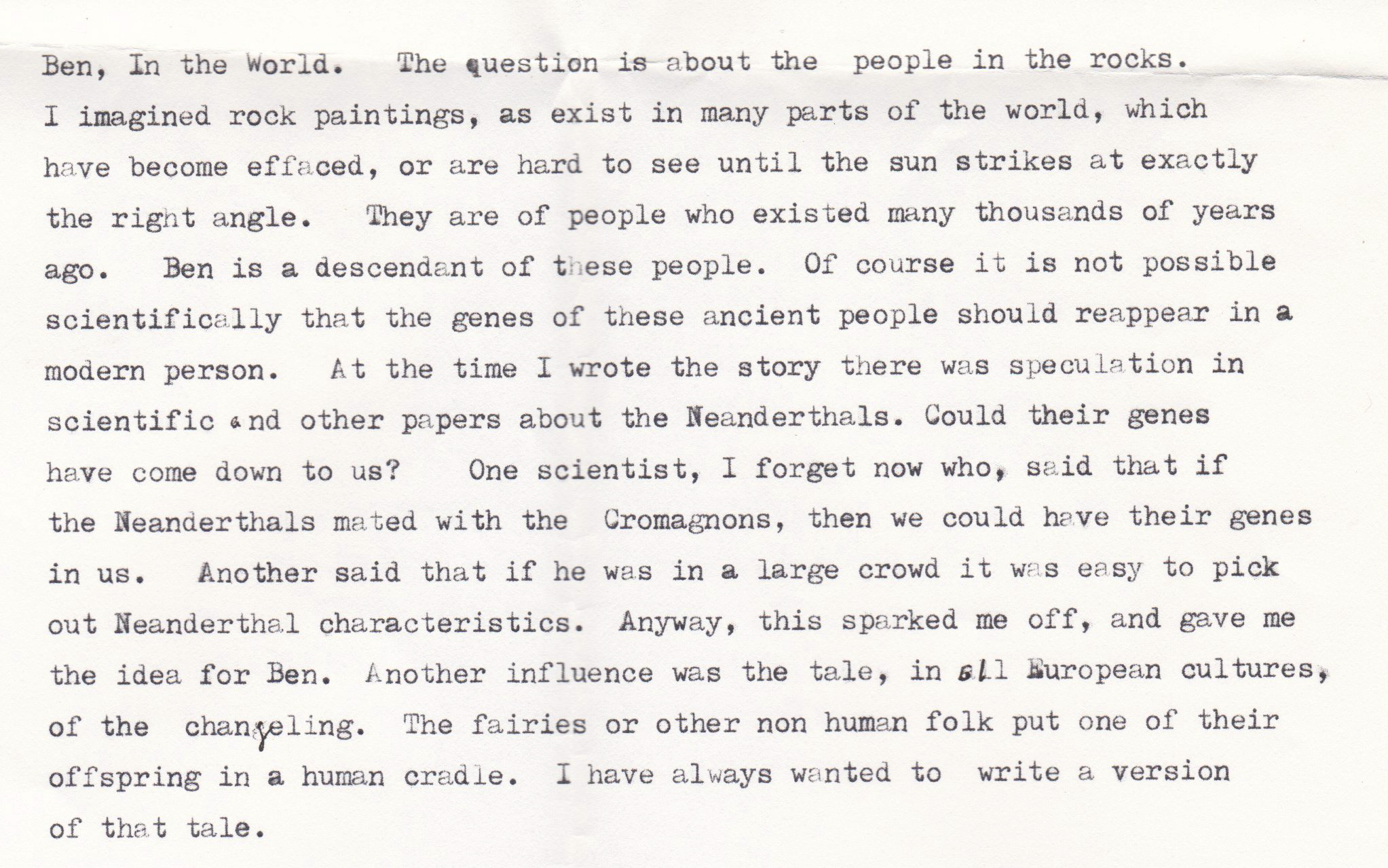
Cro-Magnon vs. Neanderthal - Doris Lessing's unfinished business with "Ben, in the World." PBS; November 18, 2013
- From a letter SwissEduc received from Doris Lessing, April 6, 2002
- Commentary
- "Ben, in the World" by Doris Lessing is a poignant exploration of alienation and the human condition. A sequel to The Fifth Child, the novel follows Ben Lovatt, an outsider who cannot conform to societal norms due to his physical differences and primal instincts. Lessing masterfully captures Ben's struggle for belonging as he wanders through a harsh world that exploits and misunderstands him.
Through Ben’s journey, Lessing critiques societal superficiality and the marginalization of those who deviate from the norm. The narrative is both tender and harrowing, emphasizing Ben’s inherent humanity despite his "otherness." Lessing’s prose is vivid, evoking empathy for a character who navigates loneliness with quiet dignity.
The novel questions what it means to be human, urging readers to reflect on compassion, acceptance, and the societal tendency to ostracize. "Ben, in the World" is a haunting meditation on difference and the fragility of human connections.
- Articles: General Information | Detailed/Scholarly Information
- General Information:
- Review : "The review summarizes the plot, character arc, and themes and gives a positive overall verdict, but it stays fairly descriptive." Fresh Ink Books; July 2, 2009
- Review : "The article offers a personal, subjective reaction rather than a detailed analytical breakdown." Cannonball; February 20, 2020
- Growing pains: "The review offers a moderately critical and detailed analysis, discussing its plot and how Lessing portrays the character and themes." The Guardian, Alex Clark; June 17, 2000
- Where in the World Is Ben Lovatt?: "The article gives a clear plot overview and some thoughts on character and narrative choices, but its analysis and its deeper themes is relatively light." O'Brian Gunn; November 30, 2019
- Sympathetic Love And Desperation Mashed Into One: "The review gives a decent summary of how the novel portrays Ben’s character and themes, reflecting on his outsider status and the emotional impact of the book, though it’s more personal than deeply analytical." WilfridWong.com; March 14, 2008
- Detailed/Scholarly Information:
- Ecofeminism. "The article provides a clear, well-structured ecofeminist reading, situating Lessing’s novel within ecofeminist theory and thoroughly discussing how environmental degradation and gender oppression intersect in the text." Translation & Literary Studies. 2017
- The Unruly Body and the regulatory Mechanisms. "The article gives a reasonably clear and academically oriented analysis that focuses on how Ben’s body and identity are constructed through social, familial, and institutional forces." Pamukkale University, Kabul. 2024
- An Ethical Reading. "The article offers a thoughtful academic ethical reading by situating Ben’s experiences in dialogue with Levinas’s ethical philosophy." Emmanuel Levinas’s ethical philosophy posits that ethics is "first philosophy," centering on an asymmetrical, pre-conscious responsibility for the Other. Wenshan Review of Literature and Culture. 2014 (pdf 27pp)